Monday, July 25, 2011

Konjic, Bosnia


We took a local train through the mountains to Konjic, a small town in between Sarajevo and Mostar. I'd read an article about Tito and an underground bunker he'd built here, capable of housing 350 people for 1 year, in the event of a nuclear war. Recently, they had turned the bunker (already a tourist attraction) into a gallery of contemporary art. So the article said...

The town of Konjic is a hidden gem, just as pretty as Mostar with its own arching stone bridge above the utterly teeth clenching cold river. (8 degrees celsius). It isn't on the tourist radar however, so it has an absence of terrible souvenir shops and harassing women trying to persuade you to stay at their house for ten euros. The tourist office, when open, seems to be operated solely by 15-year-olds taking advantage of the free internet.
"Where does the bus leave to see Tito's bunker?" I asked the boy that seemed to be in charge behind the front desk. He looked at me. "I don't know," he said. "It leaves from the bus station," I said. "Where is the bus station?"
"There are two bus stations," he said. His friend giggled next to him, and the boy looked uncomfortable. He offered me the office phone, but it didn't work. "I can show you the bus stations," he finally offered, but I knew where they were. Only I needed to know what bus station. He shrugged.
In the end, we called from Michal's mobile phone. We should have just followed the giant hodge podge of a crowd, grouping up in one part of the road. Women in headscarves mixed with a German family, an Arabic speaking family and then finally a group of Belgian scouts. Where else would we all have in common besides Marshal Tito and his bunker?

The bus took us through the small town of Konjic and into a military area sectioned off by barbed wire. "Danger, landmines" was written everywhere. Bosnian soldiers ushered us into the front room of the entrance, and produced a map of the bunker. (See first photo above). A soldier then proceeded to explain everything in Bosnian, while an apologetic guy ("sorry for my English, I'm not speaking good") translated into English, and then the leader of the Belgian scouts proceeded to translate into French. It took a llllooonnnggg time. People got bored, and they were talking. "Quiet!" Shouted the soldier. We all followed him into the dark, cold underground, where the tour began.

A strange place indeed. You could feel the fifties and sixties everywhere, old orange carpet, gray linoleum, cheap desks, and old rotary phones. Once you got deep enough, past the air filtering systems, the water reservoir, and heating, you could see the art exhibits. The apologetic fellow was trying his best to introduce people to the art, though it sounded like this: "This unit is made by German artist, and he is trying to say uhh umm...he is meeting the time of Communism and uh he is saying he can't live in it." The Belgian scouts, all teenagers in soft canvas shoes (is this a scout thing?) looked bored. There was a soldier in the back, trying to get our giant group to walk more quickly. "Quel est son problème?" one scout asked another.

Offices, living quarters, endless hallways, unexplained abstract art displays, the tour was exhausting. When we got to the living rooms, most people sat down blankly on the tweed sofas and stared at the wallpaper, all vintage. When we finally emerged back into the sun, the apologetic fellow was thanking people for visiting. "It's not a museum yet," he was saying, apologetically.
"Oh, will it be a permanent exhibit?" I asked.
"We hope so. We must talk to the municipality and agree on it."
"So it's in transition?" I asked.
"Yes," he said, happy that I had given him the right word. "In transition." Then he added quickly, "Just like Bosnia-Hercegovinia." He laughed. Our big group got back on the hot bus, and drove back to the road side station. Then we all went on our separate ways.

Thursday, July 21, 2011

Meeting the Sea


The Adriatic coast is like the jewel on an Empress's finger. Big, bold and sharp blue, the sun flares off this aquamarine and the world looks better in its light.

First, we got to Slano, a small village turned tourist spot, its modest stone homes somewhat dwarfed by the new monstrous hotel, square like a prison and fenced in to boot. It was a horseshoe town built around a quiet bay, popular with yachts and small tour boats. We were hot and bothered, having cycled a whole hell of a lot up hills and down from the first Croatian border town of Metkovic. We managed to muster enough energy to cycle around the bay to a camp ground full of Polish people. "It must be a cheap one," said Michal, grinning. And, after our next campsite in the elite Dubrovnik, we found that it most certainly was! We were told to put our tent under a tree, which had lots of sticky stuff under it. We blew up our mattresses and promptly fell asleep in the shade. After a lazy afternoon of doing nothing in the shade, we were approached by a Polish woman. She asked where we were from, and then incredulous, she asked: "Don't you like the sea?" Indeed, we laughed afterwards--it must seem strange to these people who had traveled many hours away from their windy Baltic coast to this turquoise paradise, that we had rented a campsite next to the water and then stayed away from the sea. The truth was we had swam before 9am, and then cycled on for another four hours, the sun parching our skin and turning my nose a lovely scarlet color. There was no respite from this deep, strong heat, and I couldn't face sitting on the beach.
"We've been cycling," I said, lamely. "We're tired." The woman nodded, and walked away. Probably to the beach.


Some photos of Bosnia-Hercegovinia


View from the Hostel in the center of Sarajevo
And our first view of Sarajevo, coming from the bus station out of town


Medjugoria, where in 1981 a few ten-year-olds saw the Virgin Mary. Wow, now a major shrine site, full of kitch. I bet those kids had no idea...


Neum, Bosnian coast


Boys near the bridge at Mostar. Water was sooooo cold! 8 degrees celsius!


Mural in Konjic. This little town was super deduper interesting. Houses Tito's bunker. More stories here, for another time.


The Mostar bridge and surrounding town. So many tourists! Every July there is a diving festival off this bridge, kind of wish I could have seen it.

Monday, July 18, 2011

Sarajevo, Bosnia-Hercegovinia


Editor's note:
don't travel in Eastern Europe without a computer if you expect to use the internet. This internet spot in Igalo, Montenegro, doesn't allow for usb uploading. So no pictures this time.

We took a break from cycling last week, hopped a bus in Sabac, Serbia, and within five hours (the bus overheated on one of the mountain passes. everyone got off and watched the driver pour water into the engine) we were in Sarajevo. The sun was setting against the mountains and the air was thick and hot. We cycled past tall soviet apartments splattered with bullet fire and big blast wounds, laundry on the balconies, people coming and going. We cycled past mosques, some beaming and freshly made from cement. The call to prayer sounded, and we finally found the center, some 12 km's from the suburban bus station.

The city was packed with young people. Everywhere you looked, they drank coffee, walked, biked, chatted on their stoop, drove their cars, and went to work, church, home. After living in Karlovy Vary, where the average age must be 83, this was a welcomed change.

The hostels in Sarajevo were booming, and the prices were a bit steep in comparison to our Serbian experiences. Tourists were thick like flies. We met a healthy looking girl from Canada-Canadians have a way of just looking so healthy- who had been traveling for a year. "I did Czech Republic," she said. "And then I did Hungary and Croatia." Been there, done that.

Michal didn't like Sarajevo, called it an Urbanist's LSD Dream, but I found it fascinating. I think if you come from living amid Communist Era cement bohemoths of buildings, like in CZ, you don't get a kick of their southern Slavic counterparts. To me this is still exotic.

Exit Festival


The first person to tell us about Exit was one of the priest's helpers at a monestary in Bac, Serbia. "You aren't going to Exit?" he asked us incredulously. "To what?" we asked. "The rock festival in Novy Sad." We had come into the monestary for two reasons, the first was that we were hot, and we thought the monestary looked cold. The second was that we had time to kill before the heat resided (maybe around 5, but really around 7pm)and we could cycle again. The priest was happy to have visitors, and he was busy showing us the ancient alters, old paintings and historic architecture of his monestary: Medieval, Baroque, Ottoman and Renessaince styles, a real show of the history of Central Europe.
"Ahh," said the priest, in his clear Serbian, waving his hand, and if the outside world was slightly beyond him. "The festival is full of Narkomen and Alcoholics."
"Yes," said the helper, rather wistfully. "I don't need those big rock concerts, too many people." He paused. "They say 2,000 will be there."

While we were cycling late that night, with our head lamps on, we got a lot of stares. I said hello to a lady with her kids. "You going to Exit?" She asked immediately.

The next day, a farmer began gesticulating at us from across his field. If Michal hadn't been there, I would have swore he was saying something like: "You're sitting on my property, get away from here. Go go go!" But before I knew it, Michal was walking towards this man, and thanking him. What he actually had been saying is "Come here, I have some apples for you. Come over here!" Michal came back with his shirt full of summer apples, sweet and tart and good.
"Guess what he wanted to know," Michal said. "He asked if we were going to Exit."

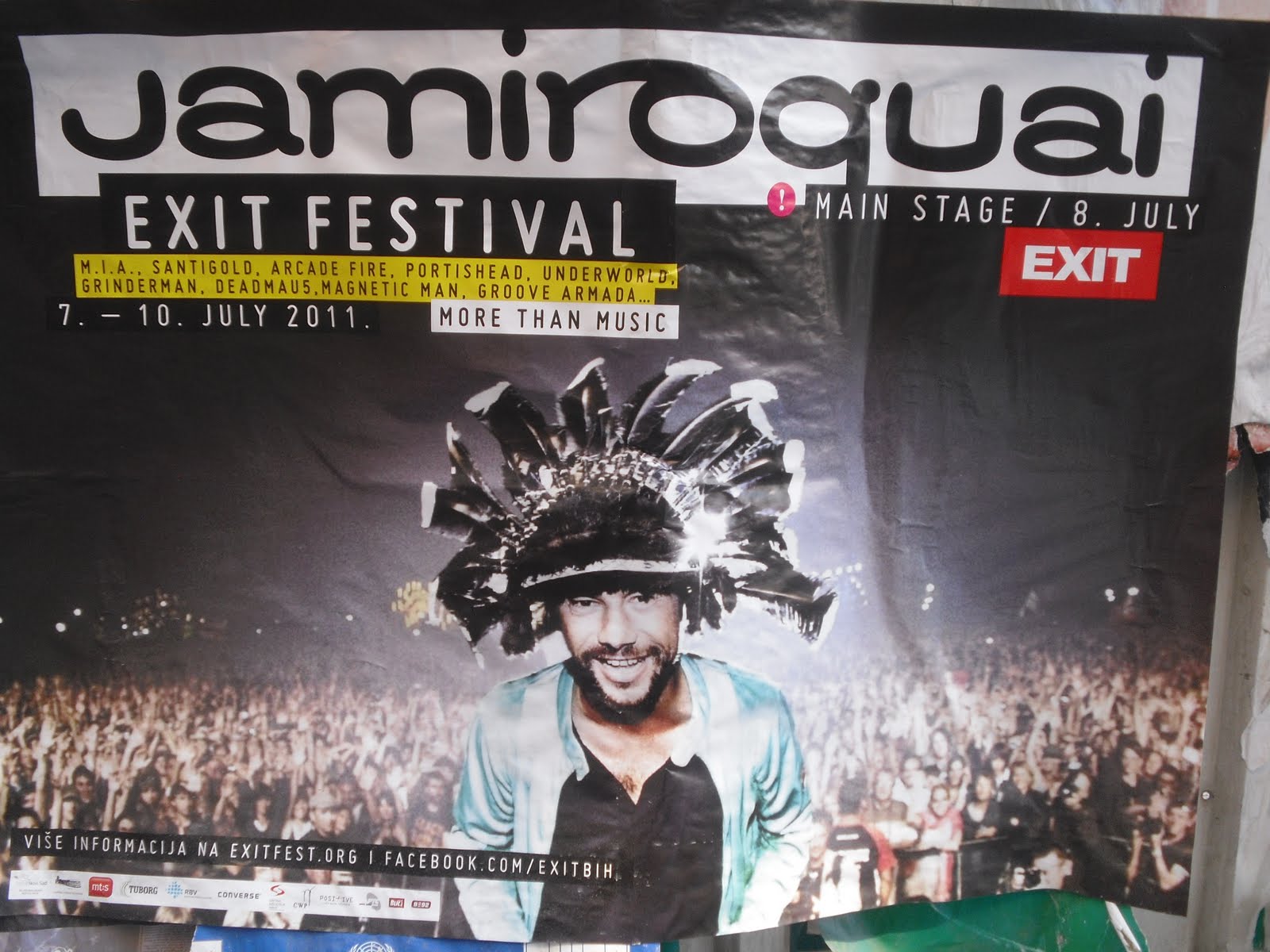
It wasn't until we got to Sarajevo, and saw this poster advertising Jamiroquoi and Arcade Fire, that we saw how big the Exit festival actually was. We spent the weekend sweating and cycling and sleeping in corn fields instead. Maybe next year....